
Colorado Freeze-Thaw Cycles and Your Chimney
The damage that shows up in spring started in October. Here is the season-by-season breakdown.
Crown cracking, mortar loss and spalling each appear in different seasons, and for a reason. AR Chimney Pros walks Front Range chimneys through every season and sees the same pattern repeat.
Front Range freeze-thaw cycles
300+ per year
Each cycle expands trapped water by about 9 percent. Multiplied across a winter, that is a structural problem.
Why Colorado's freeze-thaw cycle is so hard on masonry
The Front Range averages more than 300 freeze-thaw cycles per year, more than most U.S. regions.
A freeze-thaw cycle is a weather pattern in which temperatures drop below 32°F at night and rise above it during the day. Water trapped inside brick and mortar expands by approximately 9 percent each time it freezes. That number doesn't sound dramatic, but multiply it by 300 cycles along the Front Range and the math becomes a structural problem.
It isn't just the cold. It's the speed of the swing. Denver-area temperatures can shift 40°F or more within a single 24-hour window, which gives trapped water almost no time to drain before refreezing. Communities along the foothills, including Evergreen, Conifer and Morrison, see additional cycles because elevation amplifies overnight lows. Even metro areas like Lakewood and Arvada, sitting at roughly 5,400 feet, cycle more aggressively than low-elevation cities with similar average temperatures.
This guide walks through what happens to a chimney in each season, so you can catch damage while repair is still targeted.
Why this matters more here than elsewhere in the state
Denver Metro chimneys age faster than their construction date suggests. The Front Range microclimate is the reason.
The Front Range microclimate, the distinct weather pattern running from Fort Collins south through Castle Rock, combines high UV exposure, low humidity and rapid temperature swings. That combination is harder on masonry than wet climates or consistently cold climates.
Wet climates keep mortar joints moist and somewhat flexible. Consistently cold climates keep water frozen, which reduces active expansion events. Colorado does neither. Masonry absorption rate, the degree to which brick and mortar absorb water, is higher in porous older brick. Much of the housing stock in Lakewood, Westminster and Wheat Ridge was built between the 1950s and 1980s using brick with above-average absorption rates. Those chimneys have been cycling for 40 to 70 years, so even one winter of deferred maintenance can accelerate deterioration that was already in progress.
Newer construction in areas like Highlands Ranch and Lone Tree uses denser masonry materials. Still not immune, but the timeline to visible damage is longer.
How altitude affects draftA season-by-season look at what's happening
Fall sets it up, winter executes it, spring reveals it, summer determines what happens next.
Fall: the setup seasonCrown and north-facing mortar joints
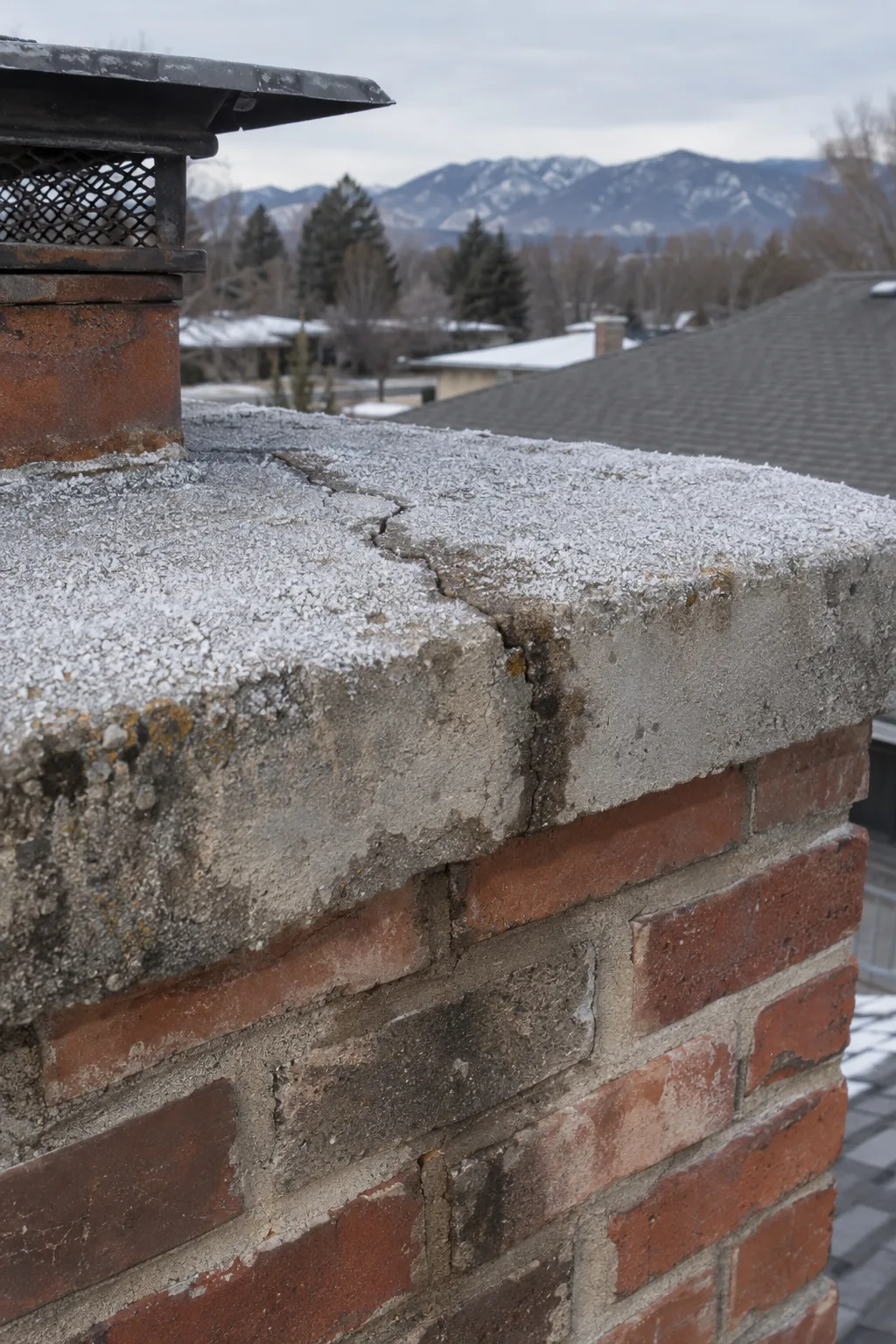
This is when the damage process actually begins. Chimneys that absorbed summer rain still hold residual moisture in their brick and mortar. As October temperatures drop, that moisture gets locked in. The chimney crown takes the first hit. Any hairline fractures from previous seasons allow water to pool and begin the freeze-expansion cycle from the top down.
Mortar joints on the north and west faces are particularly exposed. They get the least sun and dry out the slowest. By late October in Lakewood, night temperatures routinely drop into the 20s, so the first freeze-thaw cycles of the season work on a chimney that's already saturated.
What to do in fall: have your chimney inspected before the first hard freeze. A condition assessment identifies which joints are open enough to admit water and which crown cracks need sealing before winter locks in the damage.
Winter: the active damage seasonMortar joints and spalling begin
Most homeowners think of winter as the chimney's working season. It is, and it's also when the most structural damage accumulates. Each freeze-thaw cycle expands water in existing cracks by approximately 9 percent. Over 60 to 90 winter cycles in a single season, a hairline crack in the chimney crown can widen by several millimeters.
Mortar joint deterioration, the gradual erosion and crumbling of the mortar between chimney bricks, accelerates during this period. The Front Range often sees multiple freeze events per week from November through February. Every time water expands inside a joint, it pushes the mortar face slightly outward. This process is largely invisible from the ground during winter.
Spalling, the process by which the face of a brick breaks away due to internal pressure from freezing water, typically begins in mid-winter but doesn't produce visible debris until late February or March.
North-facing chimney walls experience more freeze events per week than south-facing walls, which get direct sun that raises surface temperature above freezing even when air temperature is not. If your chimney has visible damage concentrated on one side, orientation is often the explanation.
Spring: the reveal seasonSpalling becomes visible
Spring is when the damage shows up, but it didn't start here. Chunks of brick face appear on the ground. Mortar crumbles out of joints with light pressure. A crack in the chimney crown that wasn't visible last October is now wide enough to see from the yard. This is spalling reaching its visible stage after months of internal pressure.
Spring chimney inspection, conducted after the winter heating season to identify freeze-thaw damage before summer UV exposure degrades it further, is the most critical annual service for Front Range homeowners. Masonry that's exposed, open and wet going into a Colorado summer gets hit with high UV index and rapid moisture loss, which causes existing cracks to widen faster.
Catching mortar joint deterioration in spring means repointing is still targeted. Waiting until fall means more joints have opened and the repair scope has grown.
Summer: the deceptive seasonUV degradation and storm cycling
Summer looks like a rest period. It isn't. Colorado's summer UV index ranks among the highest in the continental U.S., typically reaching 9 to 11 in June and July at Front Range elevations. High UV degrades mortar binders and causes differential expansion between brick faces and mortar joints, creating micro-stress at every joint interface.
Moisture arrives in concentrated bursts. Afternoon thunderstorms are a daily occurrence along the Front Range from June through August. That rapid wet-dry cycling creates its own micro-absorption events: the chimney isn't freezing, but it is absorbing, drying, absorbing again. Each cycle degrades mortar binders and primes high-absorption brick for the next freeze season.
By late August, a chimney that looked sound in spring has absorbed another full summer of UV and storm moisture. October arrives and the cycle starts over with more entry points than the year before.
Where each season does its damage
The cycle in one line
- Fall
- Moisture locks in
- Winter
- Cracks widen, unseen
- Spring
- Damage becomes visible
- Summer
- UV and storms prime the next cycle
Situations that come up in real Front Range homes
Freeze-thaw damage doesn't look the same in every neighborhood. Here are three situations that play out differently depending on where you live.
Wheat Ridge and Edgewater
Older brick built with softer lime mortar wears faster under thermal cycling. Homeowners often find multiple mortar joints open simultaneously by spring, sometimes five to eight linear feet on the upper chimney section. The fix is repointing, but the scope depends on how deep the deterioration runs, which requires inspection before quoting.
Evergreen and Conifer
Chimney crown cracking tends to be more severe here. Elevations above 7,000 feet produce a longer freeze season and lower overnight temperatures. A crown that develops a small crack in its first winter can need full replacement by its third if left unsealed. Cast concrete crowns outperform mortar-mix crowns at elevation because they flex slightly less under thermal stress.
Highlands Ranch and Parker
The first signs of freeze-thaw damage often appear at the chimney cap or flashing rather than the brick itself. Denser modern brick resists spalling longer, but flashing expands and contracts with each temperature swing. After several years, the sealant at flashing edges cracks and water enters the roofline, not just the chimney.
What the pattern looks like after every season
Homeowners are surprised by spring damage because they couldn't see it forming.
Field notes
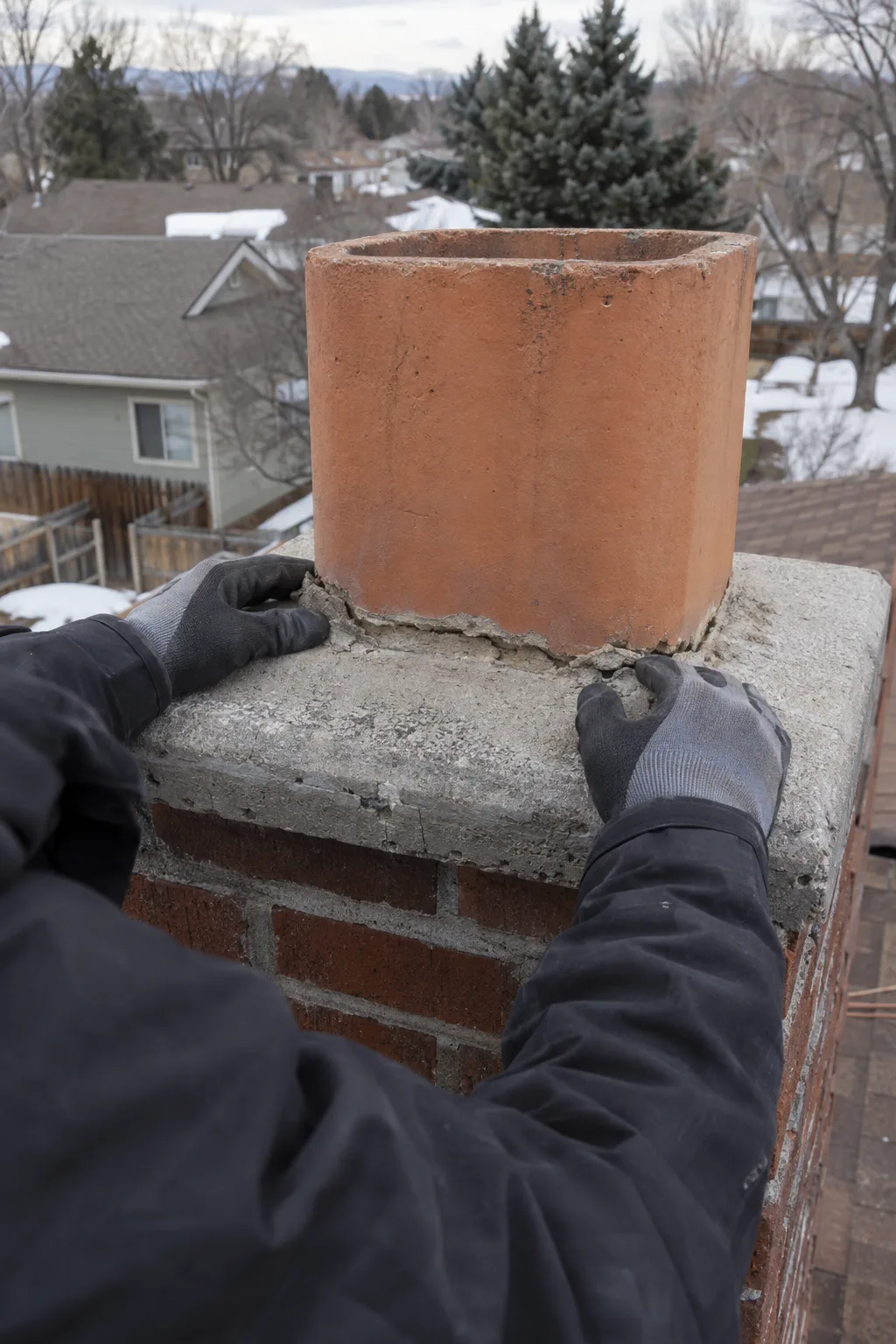
Walking up to chimneys in April where the homeowner assumed everything was fine because the fireplace worked all winter, and technically, it did, reveals a clear pattern. The firebox and flue can function while the exterior masonry is actively deteriorating. Those are two separate systems. A crack in the crown doesn't stop the fire from burning. It does invite water into the flue system, which reaches the smoke chamber and eventually the firebox.
What turns up most often in Lakewood and the western suburbs is that damage concentrates at transitions, where the crown meets the flue tile, where the brick meets the flashing, where different masonry materials meet. These are the spots where two materials with different thermal expansion rates are joined. Every freeze-thaw cycle works those seams. By the time a homeowner notices something visual on the ground, those transitions have been working loose for one or two seasons already.
The most useful thing a homeowner can do is schedule an inspection in early spring and again in early fall. Two inspections per year on a brick chimney in Colorado is not excessive. It's appropriate given the number of active cycles the masonry endures.
When it makes sense to have a pro assess your chimney
Most freeze-thaw damage is repairable when caught early. A professional inspection identifies exactly where you stand.
Brick face material has appeared on the ground near your chimney.
You can see cracks in the chimney crown or mortar that crumbles when touched.
Your chimney is over 20 years old and hasn't been inspected in the last two years.
You simply want to know what recent Colorado winters have done to your masonry.
You don't have to see obvious damage to benefit from an inspection. An experienced chimney technician can identify high-absorption brick, early-stage mortar joint deterioration, and crown surface conditions that indicate the next winter cycle will cause visible damage. Addressing those conditions with waterproofing or targeted repointing before winter is always less work than addressing spalling or structural repair in spring.
Communities we serve across the Front Range
AR Chimney Pros serves chimneys from Brighton in the north to Castle Rock in the south, the full freeze-thaw corridor.
Denver metro core
- Lakewood
- Denver
- Westminster
- Arvada
- Wheat Ridge
- Edgewater
- Englewood
- Littleton
- Sheridan
Southern suburbs
- Golden
- Morrison
- Highlands Ranch
- Centennial
- Lone Tree
- Greenwood Village
- Aurora
Foothills
- Evergreen
- Conifer
- Idaho Springs
Extended corridor
- Thornton
- Broomfield
- Louisville
- Superior
- Lafayette
- Boulder
- Longmont
- Fort Collins
- Castle Rock
- Elizabeth
Ready to know where your chimney stands this season?
A written condition report tells you exactly which components show active deterioration and which are stable.
AR Chimney Pros provides chimney inspections structured to identify freeze-thaw damage at the stage when repair is still targeted. Whether you're seeing early warning signs or simply want to know what Colorado winters have done to your masonry, schedule an inspection now.