
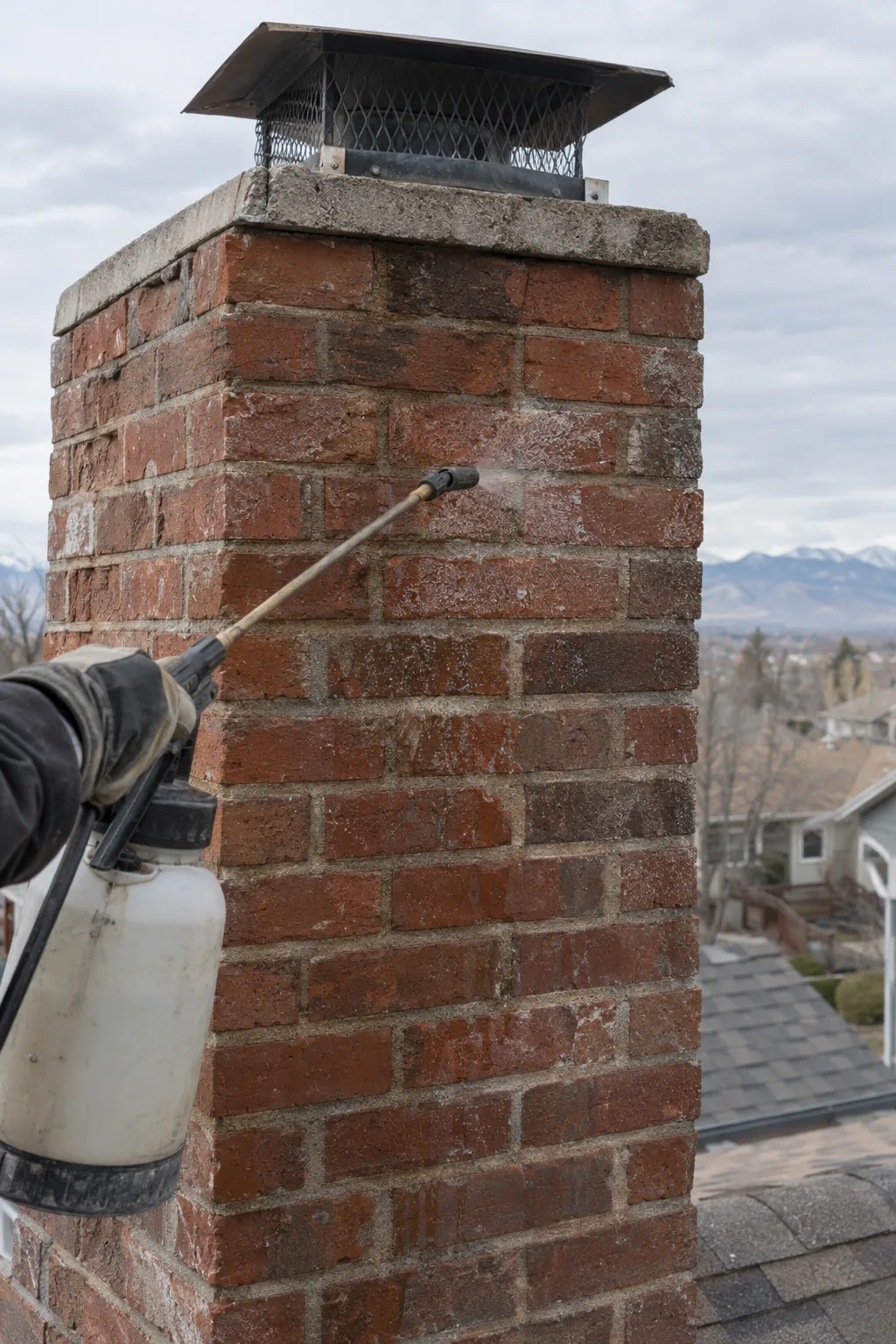
Vapor-Permeable Sealant Applied to Let Moisture Out While Blocking Water In
Film-forming hardware store sealants trap moisture, the wrong choice for Colorado winters.
Chimney waterproofing in Lakewood, CO means selecting the right sealant chemistry, not just applying any product off the shelf.
Dispatching from 12640 W Cedar Dr, Unit 7, Lakewood.
Every waterproofing job includes
- Absorption rate tested before product is chosen
- Vapor-permeable products only on masonry
- Crown, mortar joints and roofline masonry covered
- Water bead test after the sealant cures
Chimney waterproofing that works in Colorado
Vapor-permeable sealant blocks liquid water from entering masonry while letting water vapor pass outward.
That is the standard AR Chimney Pros uses on every waterproofing job. The distinction between that and a film-forming sealant matters in this climate. A film-forming sealant creates an impermeable surface barrier. That sounds protective. It isn't when moisture is already present inside the masonry substrate, and in Colorado it almost always is.
We match sealant chemistry to your specific masonry before we open a container. That's how chimney waterproofing should work.
Colorado's climate makes sealant selection technical
The freeze-thaw cycle punishes the wrong waterproofing product faster than almost any other climate.
Lakewood sits at roughly 5,400 feet. Temperatures drop hard at night even after warm afternoons. That swing between warm days and cold nights creates rapid moisture cycling inside masonry. Brick and mortar absorb daytime humidity and surface moisture. At night, that moisture needs somewhere to go.
Here is what most homeowners don't realize about Colorado chimneys: the masonry is rarely dry before winter arrives. It carries absorbed moisture from summer and fall. A treatment that seals the surface without allowing vapor to escape outward traps that moisture inside.
We dispatch to Westminster, Thornton and Broomfield along the I-25 north corridor from our Lakewood location. Those northern Denver suburbs have a high concentration of newer brick and manufactured stone chimneys, many of which have never had any waterproofing treatment. First-time waterproofing on a porous, moisture-laden substrate calls for careful sealant selection, not a one-size-fits-all product.
- 5,400 ft
- Elevation in Lakewood
- 5 to 10 yrs
- Typical sealant lifespan
- 9 percent
- Expansion of water when it freezes
Six signs, and the part of the chimney behind each one
What you notice from the ground usually points to one specific part of the stack. Open a sign to see which.
Cap Water still gets in even with a cap installed
A cap stops rain falling straight down the flue, but it does nothing for moisture already inside the brick and mortar around it. That's a sealant problem, not a cap problem.
See cap installationCrown Hairline cracks across the top of the stack
The crown sheds water off the top of the chimney. Once it cracks, every rainfall sends water straight into the masonry below. Sealant can't substitute for a sound crown.
See crown repairFlashing Water stain on the ceiling near the chimney
This is usually a flashing failure where the chimney meets the roofline, not a masonry problem at all. Waterproofing the stack won't fix a flashing gap, it's diagnosed separately.
See leak repairFlue liner White chalky residue on the interior brick
That residue is efflorescence, mineral salts left behind as moisture moves through the masonry and evaporates. It's a sign the substrate is carrying more moisture than it should.
See efflorescence removalFirebox Damp, musty smell after it rains
Moisture reaching the firebox usually means it has already travelled the full height of the stack. Worth a full leak inspection before any sealant is applied.
See leak inspectionCleanout Water pooling at the base cleanout door
Water at the base often means spalling or open joints lower on the stack are letting moisture run all the way down inside the masonry.
See spalling brick repairVapor-permeable versus film-forming
The right sealant for a Colorado chimney breathes. That single feature changes how the treatment performs.
| Vapor-permeable sealant | Film-forming sealant | |
|---|---|---|
| How it works | Penetrates masonry matrix, blocks liquid water in, lets vapor out | Forms a surface coating, blocks both liquid and vapor movement |
| Where it's appropriate | Chimneys, brick facades, masonry in freeze-thaw climates | Concrete floors, below grade applications, non-porous surfaces |
| Freeze-thaw performance | Moisture exits as vapor, no trapped expansion cycle | Trapped vapor freezes, expansion damages substrate from inside |
| Appearance after application | Invisible, no color change or sheen | May leave a slight sheen or film on the surface |
| Sealant lifespan | 5 to 10 years depending on UV exposure and substrate condition | Shorter in high UV, high freeze environments due to surface breakdown |
Sealant lifespan, the expected service life before reapplication is needed, runs 5 to 10 years on a properly applied vapor-permeable treatment. That range narrows or widens based on how much direct UV the chimney stack receives and how well the application reached saturation depth.
Our waterproofing standards
AR Chimney Pros treats chimney waterproofing as a standalone service with its own quality checkpoint. With a 20 person crew, sealant application is handled by technicians assigned specifically to that step, not rushed in as an add-on at the end of a cleaning appointment.
Call 720-608-7668- Substrate testing first Absorption rate is checked before sealant selection. Different brick types absorb at different rates.
- Vapor-permeable products only No film-forming products are applied to porous chimney stacks.
- Application saturation point confirmed The condition where the masonry has absorbed the maximum sealant volume per surface area is the target, not just a surface wet coat.
- Exposed surface treatment included Coverage extends to the crown drip edge, mortar joints and exposed masonry at the roofline, not just the visible stack face.
- Masonry substrate compatibility verified Checked before application begins, every time.
Our waterproofing process
The application sequence is built around what the masonry needs, not what's fastest.
-
1
Substrate evaluation
We check what the masonry has already been through.
Brick age, surface condition, prior sealant presence, and current moisture content are all checked. If a film-forming sealant was previously applied, we assess whether it needs to be removed before treatment. We also inspect the crown, flashing and mortar joints, because sealing over an active water entry point doesn't address the source.
-
2
Sealant application
Application follows the masonry's absorption rate, not a fixed schedule.
We apply a hydrophobic penetrant selected to match the absorption rate of the specific masonry, working in overlapping passes from the top of the stack down. The application saturation point is confirmed section by section. Coverage includes exposed surface treatment: the crown drip edge, mortar joints and roofline masonry, not just the main stack. Two coats, not one.
-
3
Post-service verification
We confirm the treatment worked before we call the job done.
After the sealant cures, we run a water bead test on multiple surface zones. Water should bead and run off cleanly. We document coverage areas and estimated sealant lifespan based on UV exposure and substrate condition. That information goes with the job record.
Waterproofing across the Denver Metro
AR Chimney Pros serves Lakewood and the full greater Denver area.
We work regularly in Lakewood, Denver, Wheat Ridge, Arvada, Englewood, Littleton, Edgewater, Morrison, Golden, Westminster, Thornton, Broomfield, Aurora, Highlands Ranch, Centennial, Boulder and Evergreen. If you're in the Denver Metro, we're your team.
Don't see your city listed? Call 720-608-7668 and we'll confirm dispatch.
Related repair services
If moisture has already caused damage, these are the services that address it directly.
Frequently asked questions
Waterproofing questions we answer most often on the phone.
How much does chimney waterproofing cost in Lakewood, CO?
Pricing varies based on substrate type, stack size and surface condition. Call 720-608-7668 for a substrate-specific quote. A proper quote includes absorption testing before any product is chosen.
Does waterproofing a chimney take more than one visit?
Most waterproofing jobs complete in a single visit. Substrate evaluation, sealant application and post-cure water bead testing happen the same day. If a prior film-forming sealant requires removal first, a follow-up appointment may be needed. Our team confirms the full scope before scheduling.
Why can't I just use the masonry sealer from the hardware store?
Hardware store sealants are usually film-forming products that block vapor movement in both directions. Trapped moisture inside your masonry freezes in winter, expands and cracks brick from the inside out. A vapor-permeable penetrant lets that moisture escape while still blocking liquid water entry. The chemistry difference determines whether the treatment helps or causes damage.
How long does chimney waterproofing last before it needs to be redone?
Vapor-permeable sealant typically lasts 5 to 10 years. UV exposure, application depth and substrate condition all affect that range. Chimneys with high direct sun exposure trend toward the shorter end. We document estimated lifespan with every job so you have a clear reapplication timeline.
What does "exposed surface treatment included" actually mean?
Coverage extends beyond the main chimney stack face. Mortar joints, the crown drip edge and exposed masonry at the roofline all receive sealant. These areas are common water entry points that a surface-only treatment misses. Skipping them leaves gaps that undermine the protection on the rest of the chimney.
See crown repairWhat if a previous owner already sealed the chimney? Does that change what you do?
Prior sealant presence changes the evaluation, not the goal. We assess whether an existing film-forming coating needs removal before a vapor-permeable product can penetrate properly. Applying a breathable sealant over an intact film layer reduces effectiveness. The substrate evaluation step catches this before any product goes on.
More questions about your system? Read the full FAQ.
Ready to seal your chimney the right way?
Chimney waterproofing in Lakewood, CO starts with choosing the right product for your specific masonry.
Call AR Chimney Pros at 720-608-7668 or email info@archimneypros.com to schedule your waterproofing service. Our team will assess your substrate, confirm the right sealant, and protect your chimney before Colorado's next freeze cycle.
info@archimneypros.com