
Rust Stains on Siding Often Trace Back to a Failing Chase Cover
The staining pattern looks like a roof or gutter problem. The cover is where it starts.
Chimney chase cover installation and repair in Lakewood, CO, with custom stainless steel covers sized to your chase opening, not a standard factory dimension.
Dispatching from 12640 W Cedar Dr, Unit 7, Lakewood.
What we confirm on one visit
- Exact chase opening dimensions
- Existing cover material and condition
- Flue collar seal and pipe fit
- Whether the stain is a cover, flashing or roof issue
Six symptoms, six parts of the chimney
Every symptom below traces back to a specific part. Open the one that matches what you're seeing.
Rust streaking down the chase siding
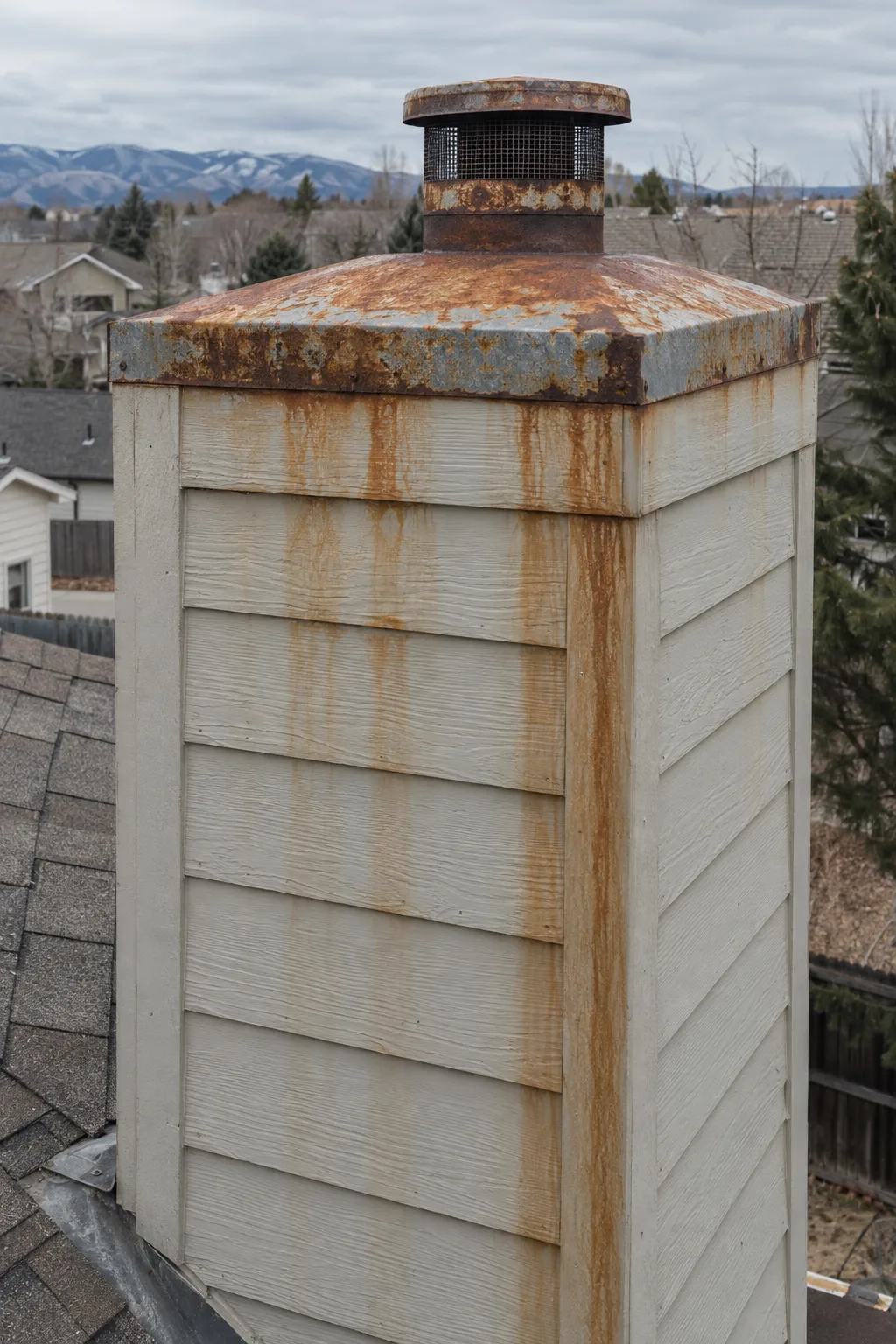
Points to the chase cover, the metal cap sealing the top of the chase. Zinc coating fails, the steel oxidizes, and rust-colored water runs straight down the siding below it. This is the page you're on.
Cracks across the concrete cap
Points to the crown, the concrete slab on a masonry chimney. Hairline cracks let water into the brick below.
See crown installationWater stains on the ceiling near the chimney
Points to the flashing, the metal seal where the chimney meets the roofline.
See leak inspectionSmoke rolls back into the room
Points to the smoke chamber, the sloped space above the firebox.
See draft analysisNo draft when you start a fire
Points to the damper, the plate that controls airflow above the firebox.
See Level 1 inspectionHeavy creosote right after a cleaning
Points to the flue liner, the passage that carries smoke up from the firebox.
See flue cleaningLakewood and its neighbors share the same cover failure timeline
Denver Metro suburbs built in the 1980s and 1990s have the same galvanized covers aging out right now.
- 8 to 15 yrs
- Past service life for 1980s to 2000s covers
- 2 visits
- Diagnostic, then fabricated install
- 4 sides
- Of drip edge checked at every install
Lakewood, Englewood, Littleton and Highlands Ranch saw enormous residential growth during those two decades. Prefab fireplaces were standard in nearly every floor plan, and the galvanized steel covers installed then are eight to fifteen years past their realistic service life.
Colorado's climate accelerates the failure. The Front Range cycles between hard freezes and dry, UV-intense days, and that freeze-thaw stress fatigues the zinc coating faster than in milder climates. By the time you see orange-brown streaking on your chase siding, often on Hardie board or painted wood, the cover has usually been perforated for a season or two already.
The staining pattern itself is a diagnostic clue. Gutter problems stain below the roofline. Chase cover rust stains start at the top of the chase structure and track straight down the field of the siding.
What a chase cover assessment actually looks like in the field
Stainless steel chase cover replacement starts with confirming the source before any material is ordered.
From the AR Chimney Pros field team in Lakewood
A homeowner off West Jewell Avenue had already had a painter look at her siding and a gutter company inspect the downspouts. Neither found the source. She had been living with a rust-orange streak on the front face of her chase for two seasons.
On the roof, the story was clear. The original galvanized steel chase cover was perforated in two places, one near the flue collar opening and one at the front edge where water pooled. The collar seal had separated, and water was tracking both inside the chase and down the exterior face. The cover had no real drip edge, the outward-angled lip that directs water away from the siding, so every rain event poured straight onto the trim cap.
What we did
The chase opening measured 14 by 20 inches, not a standard off-the-shelf dimension. We fabricated a stainless steel cover to those exact measurements, with a positive-slope profile pitching water toward the drip edge and away from the flue collar. Installed the same week.
Three months later the homeowner confirmed the staining had stopped. She repainted the siding once the chase dried out. That was the end of it.
You don't need to know which cover type you have before you call
We identify the existing cover material and chase dimensions on the same visit. No advance prep needed.
Both reader types we hear from most often get the same first step from us.
One visit. We go on the roof, measure the chase opening, assess the existing cover, and document what's there.
If you've seen the rust staining and already know the cover needs replacement, we confirm sizing and material on that first visit and schedule fabrication.
If you're not sure the chase cover is the source, we walk through the staining pattern with you and compare it to the indicators that typically point to a cover failure versus a flashing issue or a roof leak. We'll tell you clearly which one it is. If it's not a chase cover problem, we'll tell you that too.
Our standards for chase cover installation
Stainless steel, custom-sized, positive-slope. These are the baseline, not an add-on.
| Attribute | Galvanized factory cover | AR Chimney Pros stainless cover |
|---|---|---|
| Lifespan | 8 to 12 years in Colorado's climate | 25+ years, no coating to fail |
| Rust risk | High, zinc coating deteriorates under freeze and thaw cycling | Minimal, 304-grade stainless resists oxidation without coating |
| Drip edge | Minimal fold, often flush with chase framing | Extended drip edge, clears the siding line by design |
| Custom sizing | Standard factory dimensions only | Measured to exact chase opening, no forcing, no gaps |
- Flue collar fitSized to the pipe diameter with a weather-resistant seal.
- Mechanical fasteningSecured to the chase cap with fasteners, not friction fit.
- Positive slopeBuilt into the cover profile so water sheds toward the drip edge, not the collar.
- Final gap checkNo gap between cover edge and chase framing after fastening.
Chase cover installation, start to finish
Three phases, diagnostics, installation and confirmation, on every job.
-
1
Chase diagnostics
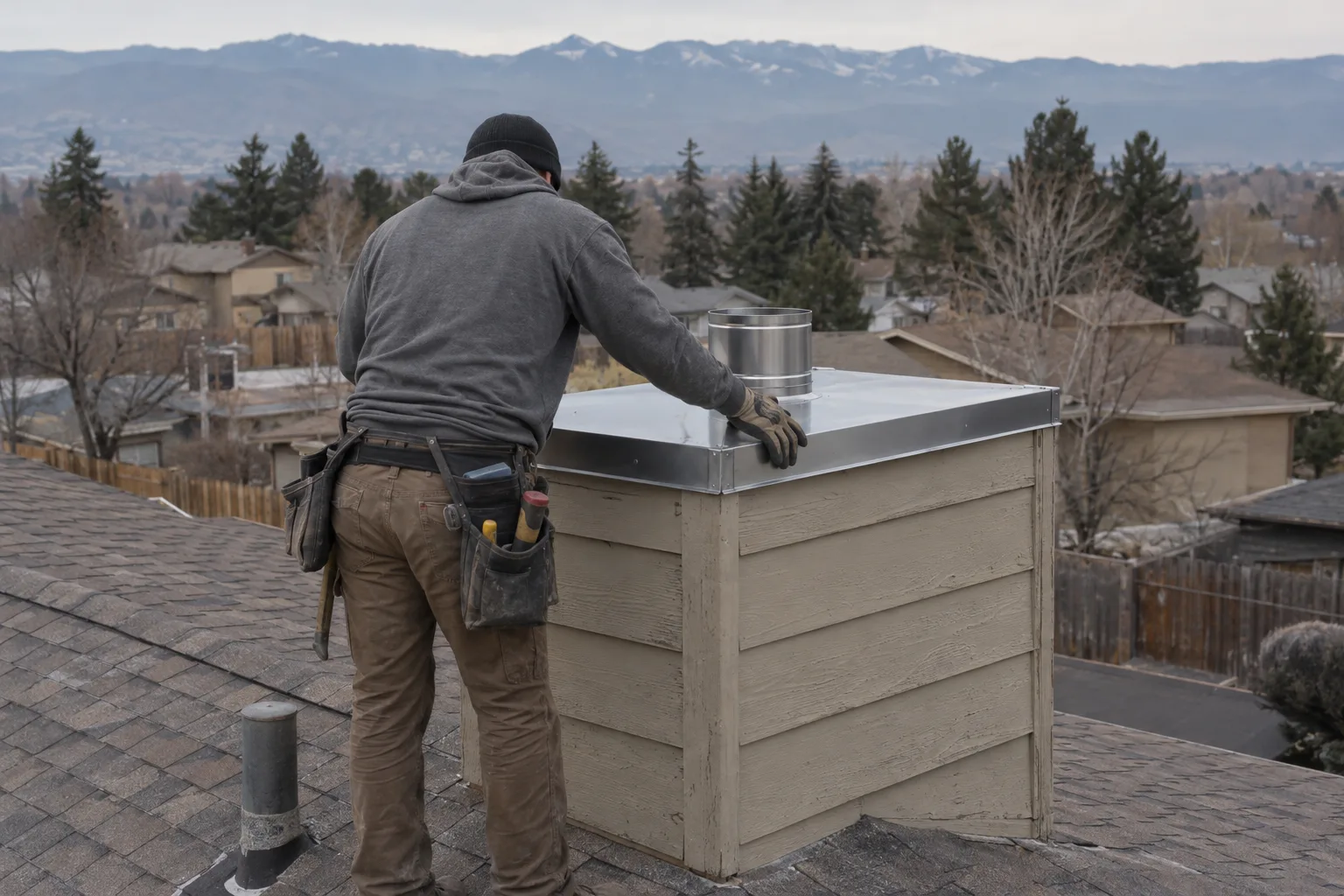
We start on the roof. The existing cover comes off after we document its condition with photos. We measure the chase opening, both interior dimensions and the chase cap framing, because a cover that doesn't match the opening will gap at the edges or require forcing.
We also check the flue collar size against the actual pipe diameter. If the chase interior shows water staining or deterioration on the flue pipe insulation wrap, we document that separately.
-
2
Fabrication and installation
Stainless steel chase covers at non-standard dimensions are fabricated to order. We schedule installation once the cover is ready. The old cover is removed and discarded, the chase cap framing is checked for soft spots or rot from prior water intrusion, and the new cover is set, leveled and fastened at the perimeter.
The flue collar is sealed at the pipe penetration point, and the drip edge is confirmed to extend past the chase framing on all four sides.
-
3
Post-installation confirmation
We walk the installation before leaving the roof. Cover slope, collar seal, fastener points and drip edge clearance are all checked. We document the completed installation with photos and review the findings with you before we leave the property.
See chimney cap installation
Areas we serve
AR Chimney Pros installs and replaces chimney chase covers across the south and west Denver Metro suburbs.
We serve Lakewood, Englewood, Littleton, Highlands Ranch, Centennial, Greenwood Village, Lone Tree, Morrison, Golden, Sheridan, Wheat Ridge, Arvada and the surrounding communities. If your home has a prefab fireplace and a wood-framed chase, we cover your area.
- Lakewood
- Englewood
- Littleton
- Highlands Ranch
- Centennial
- Greenwood Village
- Lone Tree
- Morrison
- Golden
- Sheridan
- Wheat Ridge
- Arvada
Frequently asked questions
Chase cover questions we answer most often on the phone.
How much does a stainless steel chase cover cost in Lakewood?
Cost depends on your chase opening dimensions and the cover material. Call 720-608-7668 for a quote specific to your chase.
My chase cover looks fine from the ground, do I still need a roof inspection?
Yes. A chase cover in early failure looks intact from the ground but shows rust perforation and collar separation up close. The orange-brown streaking on siding is the visible symptom, not the damage itself. One roof inspection confirms the condition in under 15 minutes.
How long does a replacement take from the first visit to a finished install?
Two visits total: one diagnostic visit to measure the chase opening, then one installation visit once the stainless cover is fabricated. Non-standard chase dimensions require custom fabrication, so there is a lead time between visits. We confirm the timeline at the diagnostic appointment before any work is scheduled.
Why does the drip edge matter if the cover is already sealed on top?
A flat cover without a drip edge channels water directly onto the chase framing and siding below it. The drip edge is the outward-angled lip that carries water past the siding line on all four sides. Factory galvanized covers typically have a minimal fold flush against the framing, and that design is the direct cause of vertical rust-stain streaking on prefab chimney homes.
Can the new cover fit my chase if it isn't a standard size?
Custom sizing is standard practice, not an add-on. Factory prefab chases were built in a range of dimensions, and off-the-shelf covers often leave gaps at the edges. We measure the exact chase opening at the diagnostic visit and fabricate the stainless steel cover to those dimensions.
What if the chase framing under the cover has already rotted?
Soft or deteriorated framing at the chase cap is documented at the diagnostic visit before installation begins. We will not fasten a new cover to a compromised cap without flagging it first. If rot is found, we identify the scope and discuss it with you before proceeding.
More questions about your system? Read the full FAQ.
Related installations
Other work we handle on prefab and masonry chimneys and fireplaces.
Schedule your chase cover assessment
A single visit confirms the cover condition, the chase dimensions and the source of any siding staining.
Call AR Chimney Pros at 720-608-7668 or email info@archimneypros.com to schedule a chase cover inspection. We serve Lakewood and the greater Denver Metro area. One visit, measured on site, fabricated to fit.