
Why Does Smoke Come Back Into My House?
Chimney backdraft isn't one problem. It's four different problems that look identical from your couch, and each one has a different fix.
AR Chimney Pros dispatches from Lakewood and covers the full Denver Metro. This guide explains the four causes of smoke rolling back into a room, why Denver's altitude makes it more likely here, and how a pressure diagnostic points to the right correction.

Where it starts
5,280 ft
Denver's elevation gives every chimney less natural draft force to begin with. Anything else that competes for air can tip the balance.
One symptom, four possible causes
You light a fire. Within five minutes, the room fills with smoke. The fireplace worked fine last winter. Now it doesn't.
Something changed, or something has been marginal for years and finally tipped over. The fix for a pressure deficit is completely different from the fix for a blocked flue. Getting the diagnosis right is the whole job.
Chimney backdraft, when smoke reverses direction and enters your living space instead of exiting the flue, is not one problem. It is four different problems that present the same way from your living room.
Denver's altitude makes backdraft more likely here
At 5,280 feet, Denver's thinner air gives every chimney less natural draft force to work with from day one.
The reduced atmospheric pressure at Denver's elevation means air is less dense. Less dense air generates less draft pressure differential, the measurable force that pulls combustion gases upward through the flue column.
A chimney that drafts perfectly in Cincinnati may underperform at elevation in Lakewood or Westminster. That's not a design failure. It's physics.
When your chimney is already working near the lower edge of acceptable draft, anything else, a cold flue, an exhaust fan running in the kitchen, a windy day, can tip the balance. The stack effect, the pressure difference between inside and outside the home, gets harder to maintain at altitude.
This is why chimney backdraft in the Denver Metro and Front Range communities requires a pressure-aware diagnosis. A visual inspection of the flue alone won't tell you whether the chimney is losing the draft fight at 5,280 feet.
See chimney draft analysisWhat happened when a Lakewood customer called about smoke in the living room
A real diagnostic appointment shows why the cause matters more than the symptom.
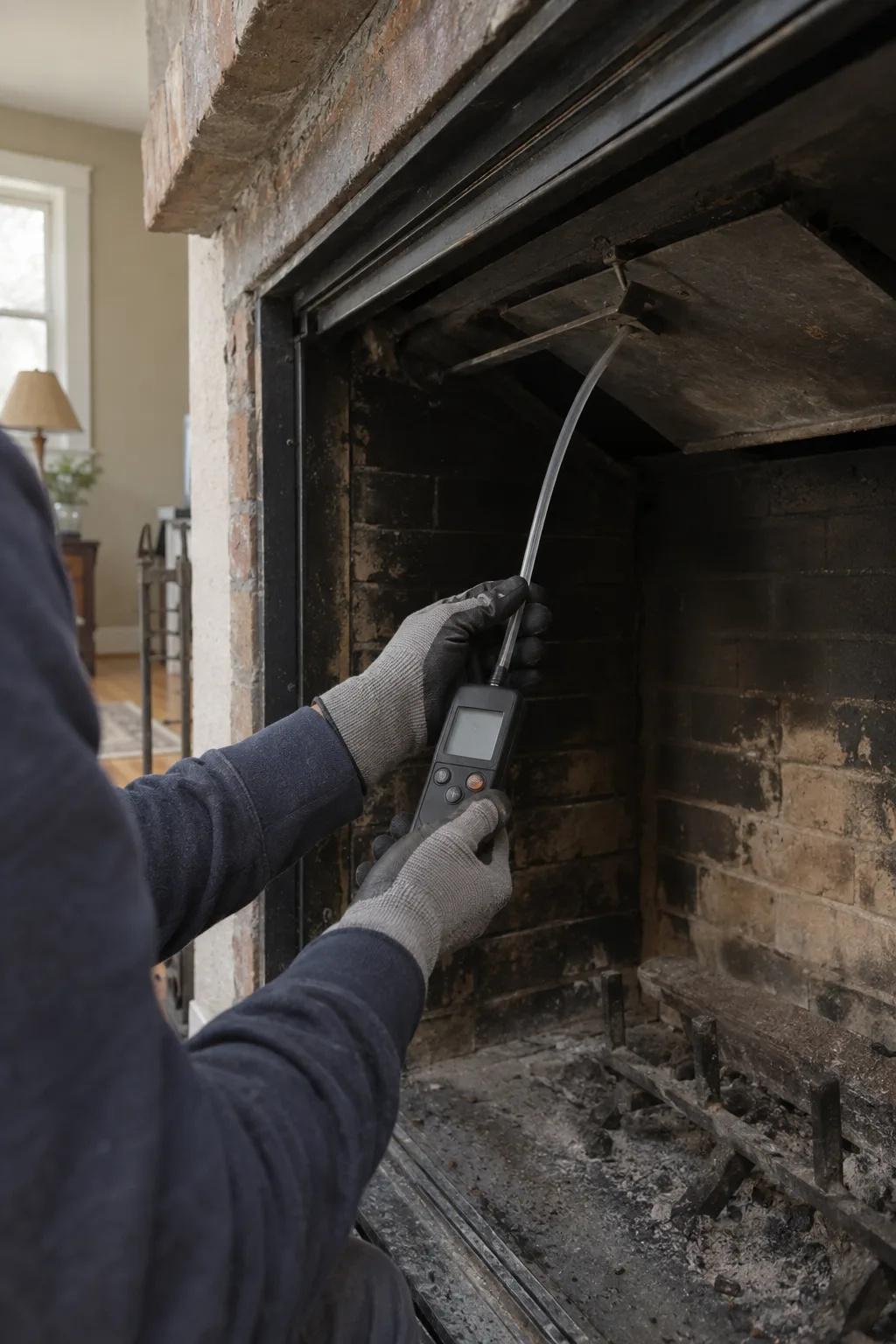
We received a call from a homeowner in Lakewood. She described the same fire she'd built for five winters in a row, same wood, same technique, same fireplace. But this January, smoke started rolling back into the room within minutes of lighting.
Her first guess was a blockage. Reasonable. But when we checked the flue, it was clear. No debris, no obstruction, good liner condition.
What had changed in the house was the real answer. She'd had a whole house ventilation system installed the previous fall. That system, along with her range hood, was creating exhaust fan interference, pulling air out of the home faster than it could be replaced. The interior of the house had become negatively pressurized.
Negative pressure, or the stack effect running in reverse, turns a chimney into the path of least resistance for outside air to rush in, not out. Her fireplace wasn't broken. Her house had become a vacuum, and the chimney was losing.
The fix wasn't a sweep or a cap replacement. We adjusted the makeup air strategy for the ventilation system and confirmed proper draft restoration through pressure testing. She lit a fire that same afternoon without a trace of smoke in the room.
That diagnostic sequence, pressure first, visual second, is the only way to match a cause to a correction.
How we run a backdraft diagnostic
Our process is built around measurable pressure data, not assumptions.
AR Chimney Pros runs a pressure diagnostic that measures actual draft conditions in your home, before and after we check the flue. At the end of that process, you know which cause applies, and we map a correction to that specific cause, not a generic service.
- 01Draft pressure differentialMeasured at the firebox opening to confirm whether the flue is generating adequate upward pull.
- 02Exhaust fan interferenceFans tested individually to identify which, if any, are depressurizing the interior.
- 03Chimney height assessmentRoofline, ridge height, and flue termination height measured against NFPA standards.
- 04Flue and liner conditionVisual and tactile inspection for blockage, deterioration, or sizing issues.
- 05Smoke guard evaluationFireplace opening height checked against firebox depth to assess whether a smoke guard would correct chronic rollout.
- 06Cold start conditionsFlue temperature assessed at call time. A cold flue can create a temporary air column that resists draft until warmed.
Every finding is documented. The correction recommendation comes from the data, not from a default service menu.
What Shapes the Outcome of a Backdraft Fix
Six symptoms, six different parts of the chimney. Open a row to see the mechanism and the fix we'd recommend.
Smoke rolls back on cold mornings, even with no wind
At altitude, a chimney already runs near the edge of usable draft. A cold start narrows that margin further, and the damper alone can't make up the difference.
See draft analysisSmoke only backs up when the range hood or bath fan runs
Fans pull air out of the house faster than it can be replaced. The smoke chamber becomes the easiest path for outside air to rush back in.
See draft analysisBackdrafts mostly on windy days, from one direction
A chimney that sits too close to the roofline catches downdraft at the cap instead of clearing it, especially in a prevailing wind direction.
See chimney cap installationSmoke backs up no matter the weather or any fan
This points to the flue itself. A restricted or damaged liner reduces the usable diameter no pressure adjustment can fix.
See relining and liner installThe room fills with smoke within minutes, every time
A firebox opening that is too large relative to the flue throws more smoke than the chimney can carry, regardless of draft strength.
See full chimney repairA sooty smell lingers in the room between fires
Creosote buildup near the base narrows the flue over time, slowing draft long before a fire is ever lit.
See creosote removalSome homes present two causes at once. That's more common in newer, tightly sealed construction in communities like Highlands Ranch or Broomfield, where energy efficient building envelopes create strong negative pressure indoors.
We serve all Denver Metro zip codes from our Lakewood location
AR Chimney Pros schedules backdraft diagnostics across the full Front Range metro, no subcontracting.
- Lakewood
- Denver
- Wheat Ridge
- Arvada
- Westminster
- Thornton
- Aurora
- Englewood
- Littleton
- Highlands Ranch
- Broomfield
- Boulder
- Centennial
- Golden
- Morrison
And surrounding Front Range communities, from Castle Rock to Longmont.
Book a draft analysis and get a specific answer today
Call AR Chimney Pros at 720-608-7668 or email info@archimneypros.com to schedule a chimney draft analysis.
We'll test actual pressure conditions in your Denver Metro home, identify the cause, and map the right correction. One appointment. One answer. No more smoke in the living room.