
When the Same Repair Fails Three Times, the Problem Is the Diagnosis
Pre-litigation, insurance dispute and contractor accountability cases are all covered.
A forensic chimney diagnostic traces a recurring failure back to its actual source and documents it in a written report you can hold, reference and submit.
Dispatching from 12640 W Cedar Dr, Unit 7, Lakewood.
What you get
- Full system investigation, not just the failed part
- Timestamped photo documentation throughout
- Formal written report within 48 hours
- Root cause findings kept separate from repair quotes
Your chimney gets a written verdict, not another guess
A forensic chimney diagnostic is a structured, evidence-based investigation that identifies the root cause of a recurring chimney failure, not just what broke, but why it keeps breaking.
Here is what most Lakewood homeowners don't realize about repeated chimney problems. Each repair was probably done correctly. The crown was replaced. The flashing was resealed. The liner was patched. And yet the leak came back the following spring, or the smoke smell returned after the first cold weekend.
That is not a materials problem. That is a diagnosis problem.
A forensic chimney inspection, a systematic, evidence-based examination designed to identify the root cause of a recurring or unexplained failure, works backward. It starts at the symptom and traces every contributing factor until the actual origin is found. The deliverable is a written findings report, something you can submit to an insurance adjuster, a contractor or an attorney, not a verbal summary at the bottom of the driveway.
AR Chimney Pros conducts these investigations for Lakewood and Denver Metro homeowners who have already tried the standard path and need a different kind of answer.
Lakewood chimneys compound problems over time
Colorado's elevation and freeze and thaw cycle create failure patterns that look isolated but often share one root cause.
Lakewood sits at roughly 5,400 feet. Winter temperatures drop fast and soil moisture freezes deep. That matters for chimneys because the expansion and contraction cycle here is more aggressive than in lower elevation climates.
A crown that cracks in its first winter isn't necessarily a bad crown. It may be the result of an improperly sloped cap installed over an unvented flue, one where moisture had nowhere to go. The crown cracked because water was already inside the system before winter hit.
Jefferson County's building stock includes a significant number of homes built in the 1960s through 1980s. Many of those chimneys have had multiple owners and multiple repairs over the decades. By the time a homeowner schedules a standard inspection, the chimney may contain components installed under three different building codes. Tracing which code applied to which repair, and whether the current system meets NFPA 211 standards today, takes documentation work, not just visual observation.
Our Lakewood dispatch location at 12640 W Cedar Dr, Unit 7 puts our forensic diagnostic crews across Jefferson County and into Denver proper on a consistent scheduling window.
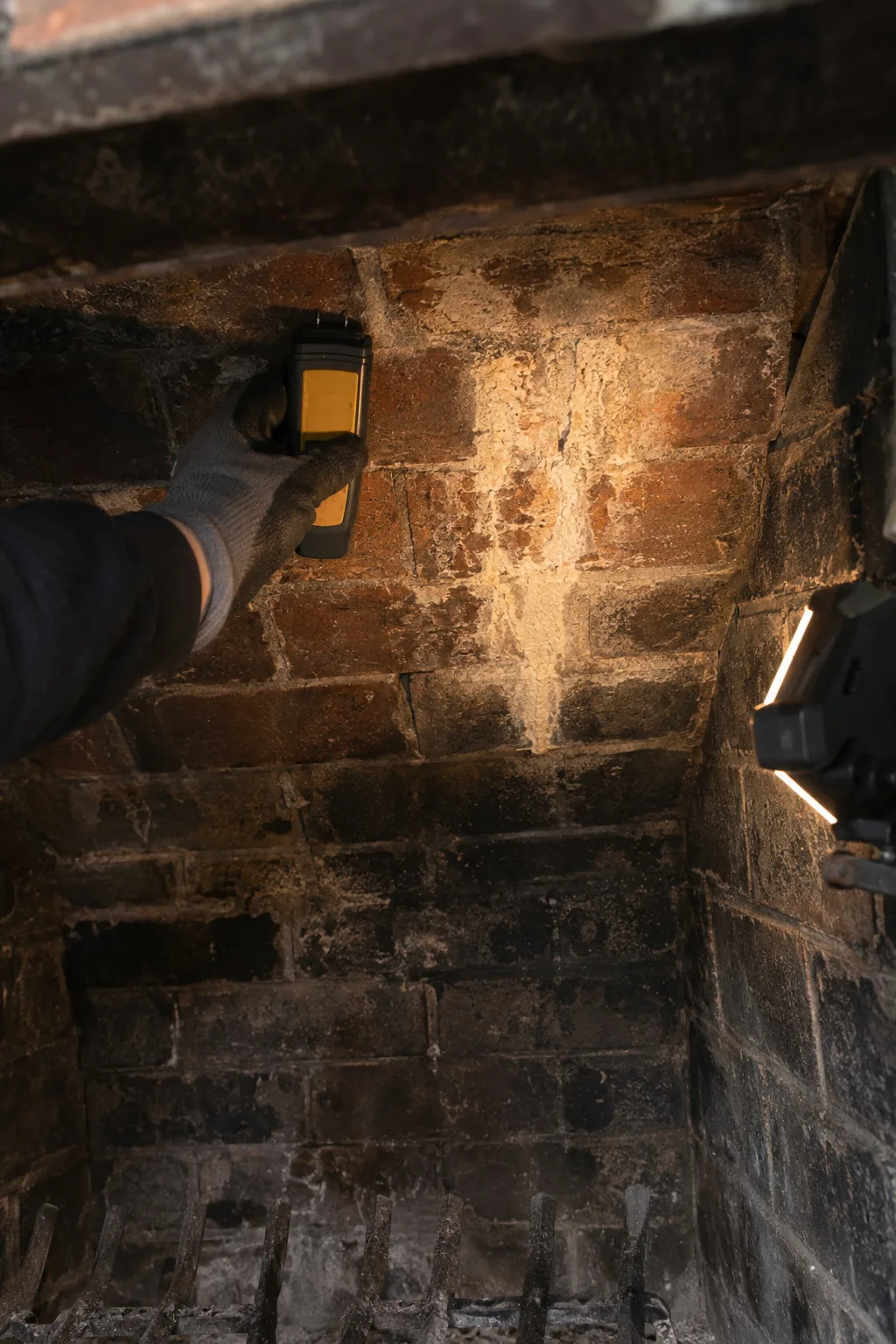
We've seen chimneys where every repair was done right, and all of them missed the same thing
A flashing repair that holds through summer and fails every spring usually means the water never came through the flashing at all.
Last winter, we got a call from a homeowner in Wheat Ridge. She had her chimney flashing repaired twice in three years. Both times the repair held through summer. Both times water came through the firebox wall the following March. The second repair used a higher grade sealant. Still failed.
When we ran the forensic diagnostic, we documented the full system: liner condition, crown slope and overhang, mortar joint integrity on the upper courses, flashing contact points, and the interior masonry above the smoke shelf. That last piece is what the previous visits had missed. The upper interior courses had active efflorescence, a white mineral deposit that signals water moving through masonry, along a seam that lined up exactly with where the flashing terminated on the exterior.
Efflorescence told us the moisture wasn't coming through the flashing joint at all. It was entering through deteriorated mortar three courses above the roofline and traveling laterally before reaching the flashing contact point. The flashing was acting as an exit, not an entry.
That is a system level chimney failure, a failure involving more than one component sharing a single root cause, not an isolated flashing defect. The written report documented the travel path, the contributing joints, and the sequence of events behind each failed repair. The homeowner used it to request reimbursement from the second contractor. That conversation went differently with documentation in hand.
The full investigation took about two hours. The report was ready within 48 hours of the appointment.
AR Chimney Pros field technician, Lakewood dispatch
Pre-litigation and insurance cases get the same process
Every forensic diagnostic follows the same protocol, whether the report is for a homeowner's records or for a legal proceeding.
Some clients come to us after a contractor dispute. Others are mid insurance claim and need an independent technical assessment before a settlement offer is finalized.
A pre-litigation chimney assessment, a forensic review conducted when an independent technical opinion is needed before a legal or insurance dispute begins, is treated identically to a standard forensic appointment.
The documentation standard doesn't change based on the intended use. We document what we find, photograph each component, and produce a written report that reflects the findings as they existed at the time of inspection.
We don't adjust conclusions based on what a client hopes to prove. That would undermine the value of the document. What we can do is make sure the investigation is thorough enough that the findings stand on their own.
Our standards for forensic diagnostic work
Documentation depth and investigation sequence are non negotiable on every forensic appointment.
Call 720-608-7668- Full system scope Every component with a logical connection to the reported failure is examined, not just the component that failed most recently.
- Photo documentation Each finding is photographed before and after any test or probing. Images are timestamped and tied to the written report.
- Written findings report The deliverable is a formal written document. A verbal summary is given at the time of the visit, and the written report follows within 48 hours.
- Root cause analysis method The investigation works backward from the symptom using root cause analysis, identifying the underlying condition, not just the visible result.
- Code reference where applicable If chimney code compliance review is relevant, findings are cross referenced against NFPA 211 and applicable local jurisdiction standards.
- A 20 person crew's depth of experience Our technicians have active field experience across cleaning, repair, relining and waterproofing. That cross service knowledge is what allows them to recognize failure patterns that span multiple components.
How the forensic diagnostic appointment works
A defined sequence. Nothing assessed in isolation.
-
1
Diagnostic phase
We review the symptom history before touching anything.
How long has the problem existed? What repairs were done, and when? What changed between the repair and the return of the symptom? This history shapes which components get priority attention during the physical investigation.
From there, the full chimney system is examined: exterior masonry, crown condition and overhang measurement, flashing attachment and contact points, liner condition, smoke chamber, damper and firebox interior. Each component is assessed for its potential contribution to the reported failure.
-
2
Documentation and targeted testing
Where findings are ambiguous, additional diagnostics are used.
This may include moisture meter readings at specific masonry locations, airflow testing to evaluate draft findings, or visual camera inspection of the liner. The goal is to distinguish a component that is failing from one that is showing symptoms of a failure occurring elsewhere.
Chimney failure documentation, the written record of findings, is built in real time during the investigation, not reconstructed afterward from memory.
-
3
Report delivery and findings walkthrough
Before leaving, the technician walks you through preliminary findings on site.
The formal written report is prepared within 48 hours and delivered by email. It includes the identified root cause, the sequence of events that led to the recurring chimney defect, all photo documentation, and any code compliance observations where applicable. Repair recommendations are listed separately from the diagnostic findings to keep the investigation record clean.
Areas we serve
AR Chimney Pros schedules forensic diagnostic appointments across the greater Denver Metro area.
We serve Lakewood, Denver, Wheat Ridge, Arvada, Englewood, Littleton, Edgewater, Morrison, Golden, Sheridan, Glendale, Westminster, Aurora, Thornton, Highlands Ranch, Centennial, Broomfield, Boulder, Evergreen, Conifer and surrounding communities throughout Jefferson County and the broader Front Range corridor.
Frequently asked questions
Forensic diagnostic questions we hear most often on the phone.
How long does the forensic diagnostic process take from appointment to written report?
The on-site investigation takes approximately two hours, and the written findings report is delivered within 48 hours. That timeline covers the full system examination, photo documentation and root cause analysis writeup. The written report is the actual deliverable, not a verbal summary given at the door. Our 20 person crew means scheduling holds across the Denver Metro without delays.
What exactly is in the written findings report, and can I submit it to my insurance company?
The written report includes the identified root cause, the failure sequence, timestamped photos, and any chimney code compliance observations. It is structured as a formal document, not a field note. Homeowners have used it for insurance claims, contractor reimbursement requests and pre-litigation review. The findings reflect exactly what existed at the time of inspection, nothing is adjusted for intended use.
What separates a forensic diagnostic from the Level 2 or Level 3 inspection I already had?
A forensic diagnostic works backward from a specific recurring symptom. Standard inspections assess current condition across the full system without a failure history as the guiding frame. Level 2 and Level 3 inspections follow defined scope protocols. Forensic diagnostics follow the evidence. Our technicians carry cross-service experience across cleaning, relining, waterproofing and repair, which lets them recognize failure patterns that span multiple components at once.
See the Level 2 inspectionCan a forensic diagnostic actually prove a previous contractor did the repair wrong?
The report documents what the investigation found, it does not assign legal fault. If the findings show a repair addressed only a symptom while the root cause remained active, that sequence is documented clearly. That documentation has supported contractor reimbursement conversations. What the report says is determined by the evidence, not by what either party hopes it will show.
My chimney looks fine now, does the recurring problem have to be active for the diagnostic to work?
No active symptom is required on the day of the visit. A recurring chimney defect leaves physical evidence even between failure cycles: efflorescence migration paths, mortar pattern deterioration, moisture meter readings and liner wear sequences. The investigation works from physical evidence in the system, not from real-time observation of a leak or smoke event.
More questions about your system? Read the full FAQ.
Related inspection services
If a forensic investigation isn't what you need yet, these cover the earlier steps.
Get a written answer to a recurring chimney problem
If the same chimney problem has returned after repair, a forensic diagnostic gives you a written root cause report, not another round of guesswork.
Call AR Chimney Pros at 720-608-7668 or email info@archimneypros.com to schedule your forensic chimney diagnostic appointment in Lakewood or anywhere across the Denver Metro. Tell us what's been repaired before and what keeps coming back. We'll take it from there.