
The Silent Threat: Why Your Gas Fireplace Requires Annual Maintenance
For many homeowners in Colorado, the convenience of a gas fireplace is an absolute game changer. With the simple flip of a switch or the press of a remote control button, you can instantly fill your living room with beautiful, dancing flames and comforting radiant heat. There is no need to chop firewood, no heavy logs to haul through the house, and no messy ash to sweep up the next morning. Because of this incredible ease of use, a dangerous misconception has taken root among modern homeowners. Many people incorrectly assume that because there is no burning wood, there is no need for maintenance.
This assumption could not be further from the truth. While gas appliances do not produce the thick, tar-like creosote that wood-burning stoves do, they are still highly complex mechanical systems that manage explosive fuel and toxic exhaust gases. Even without wood smoke, gas fireplaces require strict annual inspections to ensure safe, efficient, and clean combustion. Neglecting your gas fireplace puts your Lakewood home at risk of severe mechanical failures, expensive part replacements, and invisible health hazards. Understanding how these intricate systems work is the first step in protecting your property and your family.
The Invisible Danger of Carbon Monoxide
When natural gas or liquid propane burns perfectly, the primary byproducts are water vapor and carbon dioxide. However, perfect combustion requires an exact ratio of fuel to oxygen. If the oxygen supply inside your firebox is restricted, or if the burner ports become clogged, the fireplace will begin producing carbon monoxide. Carbon monoxide is an odorless, colorless, and tasteless gas that is highly toxic to humans and pets.
In a properly functioning vented or direct-vent gas fireplace, this toxic gas is safely drafted up the chimney or through the wall vent and expelled outside. But if your venting system is compromised by a bird nest, fallen masonry, or a damaged flue cap, those exhaust gases have nowhere to go but back into your living room. The Consumer Product Safety Commission strongly advises that all fuel-burning appliances, including gas fireplaces, be inspected yearly to prevent accidental carbon monoxide poisoning. An annual service call ensures that the exhaust pathway is completely clear and that the system is drafting correctly.
Spider Webs and the Threat of Delayed Ignition
One of the most surprising and common causes of gas fireplace malfunctions during the fall season is the local spider population. Utility companies add a chemical called mercaptan to natural gas, which gives it that distinctive “rotten egg” smell so leaks can be easily detected. Interestingly, spiders are highly attracted to the smell of this chemical additive.
During the warm summer months when your fireplace sits unused, spiders frequently crawl into the metal burner tubes and pilot light assemblies to spin dense webs. When the cold Lakewood winter arrives and you attempt to turn on your fireplace, those thick webs block the flow of gas. The gas builds up inside the firebox until it finally finds a path to the ignition spark. This results in a phenomenon known as delayed ignition. Spider webs in the burner assembly are a leading cause of delayed ignition, resulting in a miniature explosion that can shatter the glass doors of your fireplace. A professional technician will completely dismantle and clean the burner tubes to ensure smooth, immediate ignition.
The Millivolt System: Thermocouples and Thermopiles
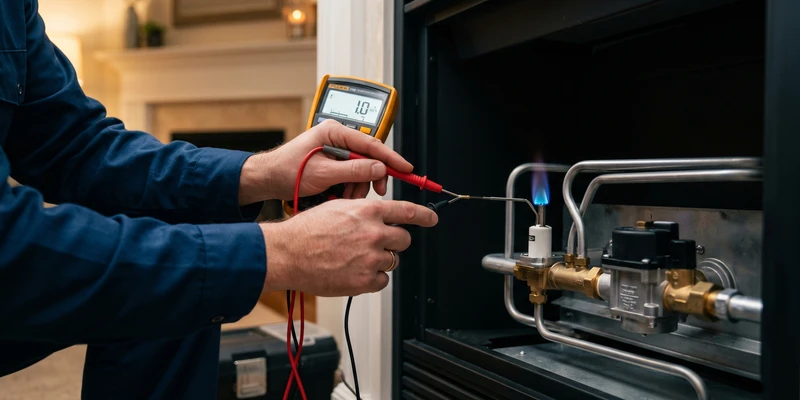
Your gas fireplace relies on highly sensitive electronic components to operate safely, most notably the thermocouple and the thermopile. These small metal sensors sit directly in the flame of your pilot light. As the flame heats the metal, these sensors generate a tiny electrical current, measured in millivolts. This small electrical charge is what signals the main gas valve to open and close.
Over time, the pilot flame leaves a buildup of carbon and white sulfur residue on the surface of the thermocouple. As this residue thickens, it insulates the metal, preventing it from reading the heat accurately. When the sensor fails to register the heat, it assumes the pilot light has blown out. As a safety precaution, it immediately shuts off the main gas valve, meaning your fireplace will refuse to turn on no matter how many times you flip the switch. Regular expert fireplace repair and maintenance involves carefully cleaning these delicate sensors with abrasive pads and testing the millivolt output with a multimeter to prevent unexpected winter breakdowns.
Ceramic Log Placement and Soot Accumulation
The artificial logs in your gas fireplace are meticulously crafted from specialized ceramic fibers designed to withstand extreme heat. They are also arranged in a highly specific, engineered pattern. Every log is positioned to allow the gas flames to flow smoothly around them without making direct contact. If you move the logs while cleaning, or if they shift accidentally, the flames will directly impinge on the ceramic material.
When a flame hits an obstacle, the temperature of the flame drops, causing incomplete combustion. This immediately produces a thick, black soot that coats the logs, the glass, and the interior walls of the firebox. A buildup of black soot inside a gas fireplace is a critical warning sign that your burner is misaligned or your logs are incorrectly positioned. A certified technician will vacuum out the existing soot and use the manufacturer schematic to place every ceramic log back in its exact, factory-approved position.
The Etched Glass Problem
If you own a direct-vent gas fireplace, you have likely noticed a cloudy, white film developing on the inside of the sealed glass front. This is a normal byproduct of the combustion process. As the gas burns, it releases minerals and sulfur compounds that condense on the cooler surface of the glass when the fireplace is turned off.
While the film is normal, ignoring it is a costly mistake. If the white residue is left on the glass and repeatedly subjected to the intense heat of the fire, the minerals will permanently bake into the pores of the glass. This process, known as etching, destroys the clarity of the glass permanently. No amount of scrubbing will remove etched stains, and the only solution is to buy an expensive replacement glass panel. During an annual service, technicians use specialized, non-ammonia cream polishes designed specifically for ceramic fireplace glass to safely lift the sulfur film without scratching the surface.
High Altitude Adjustments in Colorado
Living in the Denver metropolitan area presents a unique challenge for gas appliances. At our high altitude, the air is significantly thinner and contains less oxygen than at sea level. Because combustion requires oxygen, a gas fireplace calibrated for sea level will burn far too “rich” in Lakewood, meaning it is pushing too much fuel and receiving too little air.
A rich-burning fireplace produces excessive soot, creates foul odors, and wastes expensive fuel. Gas appliances in our region must be properly de-rated by adjusting the gas valve and modifying the primary air shutter. The Chimney Safety Institute of America requires certified sweeps to understand the strict parameters of high-altitude gas adjustments. Having a local expert tune your specific air-to-fuel ratio ensures that you get maximum heat output with zero toxic byproducts.
Protect Your Investment and Your Peace of Mind
A gas fireplace is a premium feature that adds substantial value and comfort to your home. Treating it as a completely maintenance-free appliance is a gamble that ultimately leads to frustrating part failures, unappealing soot stains, and potentially dangerous gas leaks.
Just like your car or your HVAC system, your fireplace needs professional attention to run at peak performance. By scheduling comprehensive maintenance for all your household gas appliances before the heavy winter weather arrives, you can confidently flip that switch on a snowy evening, knowing your system is perfectly tuned, impeccably clean, and entirely safe for your family to enjoy.






Leave A Comment