
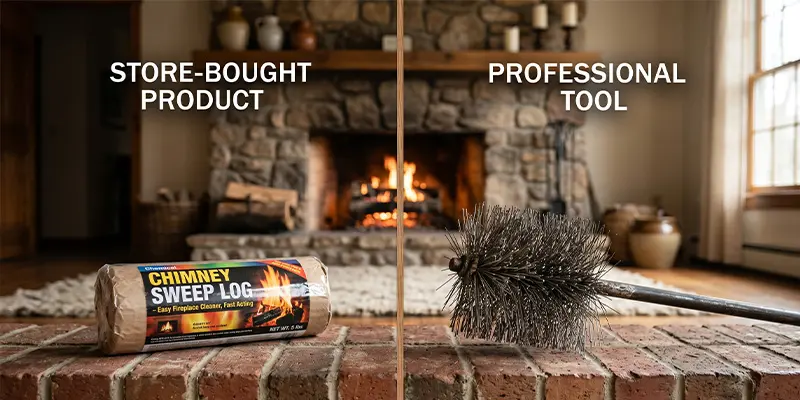
The Truth About Chemical Chimney Cleaning Logs: Do They Actually Work?
As the cold weather settles into Colorado, many homeowners look for quick and convenient ways to prepare their fireplaces for the long winter season. A walk down the heating aisle of any local hardware store will reveal shelves stacked high with chemical chimney cleaning logs. The packaging on these products often features bold claims, promising to strip away dangerous buildup and make your fireplace instantly safe with the simple strike of a match. For a busy homeowner in Lakewood, the idea of dropping a pre-packaged log into the firebox instead of scheduling a service call is incredibly appealing.
However, when it comes to the safety of your home and the well-being of your family, taking shortcuts can lead to devastating consequences. Fireplace maintenance is a complex mechanical process that cannot be completely solved by a burning chemical additive. Chemical cleaning logs are a maintenance supplement, not a replacement for a professional physical chimney sweep. Relying entirely on these products creates a dangerous false sense of security that leaves your property highly vulnerable to restricted airflow, toxic gas exposure, and catastrophic chimney fires. Understanding exactly how these logs work, and what they fundamentally fail to do, is crucial for responsible homeownership.
How Chemical Sweeping Logs Actually Function
To understand the severe limitations of a chemical cleaning log, you first need to understand the basic science behind how they interact with your flue. These products are essentially compressed blocks of sawdust bonded together with waxes and specific chemical additives, most commonly a compound called trisodium phosphate. When you place the log in your fireplace and ignite it, the log burns at a high temperature and releases these active chemicals directly into the smoke.
As the chemical-laden smoke travels up the chimney stack, it adheres to the existing creosote on the masonry walls. Creosote is the natural, highly combustible tar that forms when wood smoke cools and condenses inside the liner. The chemicals in the sweeping log act as an aggressive drying agent. Over the course of a week or two, the chemical treatment causes the sticky, tar-like creosote to dry out, turn brittle, and eventually begin to flake apart. The goal of the product is to alter the chemical composition of the creosote so that it is less likely to catch fire during your next burn.
The Hidden Danger of Falling Debris
If the chemical log works exactly as advertised and successfully dries out the creosote, you are immediately faced with a secondary, often ignored problem. When the brittle creosote detaches from the vertical walls of the chimney liner, it does not magically vanish into the atmosphere. Gravity takes over, and those highly flammable flakes fall directly down the chimney stack.
In a standard masonry fireplace, these flakes will crash down and accumulate on the smoke shelf. The smoke shelf is a flat, horizontal ledge located just behind your damper, designed to catch downdrafts and prevent rain from entering the firebox. When hundreds of dry creosote flakes pile up on this hidden shelf, they create an extreme fire hazard. A stray spark from your next fire can easily ignite this concentrated pile of fuel resting just inches above your living room. The only way to safely remove this fallen debris is for a certified technician to physically vacuum the smoke shelf using high-powered industrial equipment.
The Three Stages of Creosote and Chemical Limitations
Another major flaw in relying solely on chemical logs is their complete inability to treat severe buildup. Creosote forms in three distinct stages, each more dangerous and difficult to remove than the last. Stage one is a light, velvety soot. Stage two is a crunchy, hardened tar. Stage three is a dense, highly concentrated black glaze that looks exactly like melted black glass coating the inside of your flue.
Chemical logs can be somewhat effective at drying out stage one soot and early stage two creosote. However, they are completely powerless against stage three glaze. The chemical smoke simply glides over the thick, hardened surface without penetrating the dense tar. Attempting to clear severe stage three creosote with a store-bought log is completely ineffective and leaves your home at immediate risk of a high-temperature flue fire. Stripping away stage three glaze requires specialized rotary chains and commercial-grade chemical treatments applied directly by trained professionals.
What a Chemical Log Cannot Diagnose
Perhaps the most significant danger of using a chemical log as a substitute for a physical sweep is the loss of the diagnostic inspection. Your chimney is a massive structural column that endures extreme thermal shock and harsh winter weather year after year. Over time, the internal clay tiles can crack, the mortar joints can deteriorate, and moisture can rust the damper assembly.
A chemical log cannot patch a cracked flue liner. It cannot tell you if a squirrel or bird has built a nest that is blocking your exhaust pathway. It cannot alert you to missing mortar joints that might allow deadly carbon monoxide to leak into your upstairs bedrooms. The National Fire Protection Association explicitly states that all chimneys, fireplaces, and vents must undergo an annual physical inspection to verify structural integrity and ensure the system is free of obstructions. Burning a log simply does not meet this critical, life-saving safety standard.
The Crucial Role of Mechanical Sweeping
There is absolutely no substitute for the mechanical friction provided by a professional sweeping brush. Certified technicians use specialized, stiff-bristled wire or polycarbonate brushes sized exactly to the specific dimensions of your flue. By physically scrubbing the liner from the top down, they forcefully detach stubborn creosote and remove it entirely from the system, rather than just drying it out and letting it fall onto your smoke shelf.
Furthermore, professional sweeps utilize advanced technology to ensure the job is done perfectly. By scheduling an advanced camera inspection, technicians can run a high-definition video feed up the entire length of the chimney. This allows them to visually verify that all combustible material has been completely removed and that the internal masonry is intact, providing a level of safety assurance that a chemical product can never deliver.
When Is It Actually Safe to Use a Sweeping Log?
This does not mean that chemical sweeping logs are completely useless or should be banned from your home. When used correctly and with proper context, they can be a helpful tool in your overall maintenance strategy. The proper time to use a chemical log is during the middle of the heavy burning season, provided your chimney was already professionally cleaned and inspected during the fall.
Using a log mid-season can help dry out the fresh, light layer of stage one soot that has accumulated over the holidays, making it easier for your technician to brush away during the following year’s service appointment. The Chimney Safety Institute of America recognizes that chemical modifiers can assist in routine maintenance, but they strictly advise homeowners that these products must be used in conjunction with, and never instead of, routine mechanical sweeping.
How the Colorado Climate Affects Creosote Buildup
Living in the Denver metro area adds another layer of complexity to fireplace maintenance. The extreme temperature fluctuations we experience in Colorado actively accelerate the formation of creosote. When you light a fire, the hot smoke hits the freezing cold masonry of the exterior chimney stack. This rapid temperature change causes heavy condensation, meaning creosote builds up much faster here than in warmer, more temperate climates.
Because of this accelerated buildup, Lakewood homeowners cannot afford to rely on half-measures. A chemical log might lightly treat the surface of the soot, but it will not clear the heavy condensation layers caused by a freezing Colorado night. Only a physical scrubbing can ensure the diameter of your flue remains wide open and safe for drafting.
Prioritizing Your Home Safety
Taking shortcuts with fireplace safety is a risk that you simply cannot afford to take. While the marketing text on the side of a chemical log box might sound like the perfect, inexpensive solution, the physical reality of chimney mechanics is far more complicated. If you want to enjoy a warm, comforting fire with total peace of mind, you must ensure that your exhaust system is physically clear and structurally sound.
Before you light your first fire of the season, skip the hardware store aisle and rely on trained expertise. Booking comprehensive professional chimney sweeping services guarantees that the hazardous creosote is entirely removed from your property, your smoke shelf is vacuumed clean, and your flue is confirmed safe to operate. Investing in proper mechanical maintenance protects your family, preserves your historical masonry, and allows you to enjoy your fireplace the way it was truly meant to be experienced.






Leave A Comment